


Why Change Management Is the Difference Between AI Adoption and AI Success
April 15, 2026

Why Change Management Is the Difference Between AI Adoption and AI Success
Artificial intelligence is rapidly becoming a core part of enterprise strategy. From automation to advanced analytics, organizations are investing in AI to improve efficiency, strengthen decision-making, and support growth.
But deploying AI tools is only the first step.
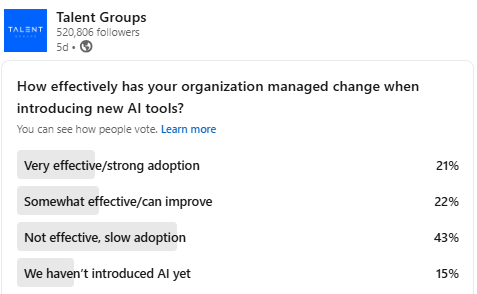
In a recent
Talent Groups LinkedIn poll, 65% of respondents said their organizations had not effectively managed change when introducing new AI tools, while only 21% reported very effective change management and strong adoption. That gap highlights a common challenge: organizations may be moving forward with AI, but many are still struggling to communicate the why, guide teams through the change, and create the support structure needed for adoption to stick.
Many organizations struggle to realize the full value of AI because adoption stalls, usage is inconsistent, or teams revert to familiar ways of working. According to McKinsey & Company, while AI adoption has reached nearly 80% of organizations, more than 80% report no meaningful impact on their bottom line. Adoption depends heavily on user behavior, not just system accuracy. The gap isn’t in the technology; it’s in how the organization prepares for and manages change.
AI Adoption Requires More Than Implementation
AI changes how work gets done across teams and functions:
- Employees shift from manual execution to oversight and validation
- Decision-making becomes more data-driven and AI-supported
- Workflows evolve to incorporate new tools and processes
Without a structured approach to change, organizations often see:
- Low or inconsistent adoption
- Misalignment between teams and business goals
- Hesitation driven by lack of clarity or trust
- Delayed or unrealized ROI
AI adoption is not a one-time rollout. It’s an organizational shift that requires clear communication, defined processes, and ongoing support.
Why Change Management Is Critical to AI Success
Driving Consistent Adoption Across Teams
Successful AI adoption depends on consistent usage. Change management ensures:
- Clear guidance on when and how to use AI tools
- Alignment between new technology and existing workflows
- Reinforcement of adoption through leadership and accountability
Addressing Resistance Early
AI often raises valid questions around job impact, accuracy, and reliability. A proactive change strategy:
- Provides transparency around how AI will be used
- Clarifies expectations and workflows
- Builds confidence through practical, hands-on experience
Connecting AI to Business Outcomes
AI initiatives must be tied to measurable results. Change management helps:
- Link AI use cases to specific business goals
- Define success metrics across teams
- Track performance and identify areas for improvement
Supporting Responsible and Compliant Use
AI introduces new considerations around data privacy, governance, and bias. A structured approach ensures:
- Clear policies and usage guidelines
- Alignment with compliance and regulatory requirements
- Appropriate balance between automation and human oversight
The Role of Agile Advisory & PMO Leadership in AI Adoption
AI initiatives require flexibility, speed, and continuous improvement—but they also require structure, governance, and clear accountability. Static rollout plans often fall short in a quickly changing environment.
Talent Groups brings together our Agile/SAFe Practice and PM Center of Excellence (COE) to help organizations adopt and scale AI with both agility and control.
We support AI initiatives by helping organizations:
· Test and refine AI use cases through iterative, real-world delivery
· Align stakeholders across business, IT, and data teams to ensure shared priorities
· Establish governance frameworks that support both speed and oversight
· Define clear roadmaps, ownership, and success metrics across initiatives
· Continuously measure performance and adjust based on results
By combining Agile execution with strong PMO leadership, organizations can move quickly while maintaining visibility, alignment, and long-term scalability.
Talent Groups’ Change Management Services for AI Initiatives
We help organizations integrate AI into their operations in a way that drives real, sustained results. Our approach focuses on clarity, alignment, and execution.
Change Strategy & Readiness
- Assess organizational impact and readiness for AI adoption
- Define stakeholder communication plans
- Identify risks and mitigation strategies early
Training & Workforce Enablement
- Deliver role-based training aligned to real use cases
- Provide practical guidance on applying AI tools in daily work
- Prepare leaders to reinforce adoption and expectations
Adoption & Integration
- Align AI tools with existing workflows and processes
- Support teams through transition and early adoption phases
- Monitor usage and adjust strategies to improve outcomes
Governance & Ongoing Support
- Establish clear policies for responsible AI use
- Support compliance, security, and risk management efforts
- Provide ongoing guidance as AI capabilities evolve
From AI Deployment to Business Impact
Organizations that treat AI as a technology deployment often struggle to see results. Those that invest in change management alongside AI initiatives are better positioned to:
- Accelerate adoption across teams
- Improve consistency and quality of usage
- Reduce risk and uncertainty
- Achieve measurable improvements in performance
Build a Scalable Approach to AI Adoption
AI will continue to change and grow, and so will the way organizations use it. A structured, adaptable approach to change ensures your teams are prepared to keep pace.
Talent Groups brings together change management expertise and PM and Agile advisory services to help organizations adopt AI with clarity, consistency, and measurable outcomes.
Ready to strengthen your approach to AI adoption?
Let’s connect.

By Amy Carabase
•
September 28, 2026
Key takeaways from AI in Action Las Vegas on practical AI adoption, operational value, governance, talent strategy, and keeping people at the center.

By Amy Carabase
•
September 21, 2026
Discover why today’s IT talent challenge is about skills, not headcount, and how organizations can close gaps across AI, cloud, data, and cybersecurity.

By Amy Carabase
•
August 11, 2026
Technology and workspace tools for left-handed professionals, including mice, keyboards, lap desks, and tips for a more comfortable setup.