




IT Careers in 2026: What Hiring Managers Want and How to Prepare Now
January 18, 2026

IT Careers in 2026: What Hiring Managers Want and How to Prepare Now
The IT hiring landscape is changing in 2026. According to Gartner’s Top Strategic Technology Trends for 2026 , companies are no longer just experimenting with AI, they are operationalizing it, securing it, and focusing on making long-term investments that support their business. For IT job seekers, this shift is showing up directly in what hiring managers are prioritizing. In 2026, in-demand skills include AI-enabled delivery, cybersecurity and digital trust, cloud and cost optimization, and the ability to modernize systems without disrupting the business.Here are five practical recommendations to help you stand out and land your next role in 2026.
1) Become “AI-capable” in your lane (and prove it with outcomes)
AI is no longer a specialty skill reserved for a few roles. It’s becoming an expectation across engineering, data, infrastructure, and even IT operations. The differentiator is not “I’ve used ChatGPT”, it’s how you apply AI responsibly to improve delivery .
What to do in 2026
- Focus on one or two AI use cases that align directly with your role, such as test generation, log analysis, runbook drafting, ticket summarization, or code review checklists.
- Create a tangible proof point: a small GitHub project, a brief case study, or a one-page “before and after” summary that shows impact on speed, quality, or reliability.
- Be prepared to speak to responsible use, including data handling, access controls, prompt hygiene, and situations where AI should not be used.
The
World Economic Forum
highlights that while AI adoption is accelerating, employers are placing growing emphasis on practical application, risk awareness, and measurable value. In 2026, IT professionals who can clearly connect AI use to real business results without increasing risk will be the ones hiring managers remember.
“When we talk with candidates about AI, we’re not looking for perfection or deep specialization,” says Amy Migliore, VP of Recruiting & Delivery. “What we encourage is intentional use. Pick a few ways AI can genuinely support your work, whether that’s improving documentation, speeding up analysis, or helping you prepare more effectively. Be ready to explain where it adds value, where it doesn’t belong, and how you’re using it responsibly. That clarity is what hiring managers are responding to right now.”
2) Lean into security and identity even if you are not “a security person.”
Security is no longer a standalone function. It is increasingly embedded into nearly every IT role, especially as threats become more automated. Even if your job title does not include the word security, hiring managers are actively looking for candidates who can demonstrate that they build, deploy, and operate systems with security in mind.
This expectation applies across infrastructure, cloud, DevOps, application support, data, and identity focused roles.
What to do in 2026
- Weave security language into your experience and interview stories. This includes concepts like least privilege, secrets management, multi-factor authentication, zero trust alignment, vulnerability remediation, and audit readiness.
- If you work in cloud or DevOps, be prepared to explain how you reduce risk through practices such as policy as code, secure CI/CD pipelines, logging and monitoring, and participation in incident response.
- If you are early in your career, pursue a foundational security credential and pair it with a practical lab or hands-on project to demonstrate initiative and real-world understanding.
Why this matters
Research from ISC2
shows that cybersecurity talent shortages continue to be a major concern for employers, with workforce gaps increasing organizational risk and strain on existing teams. At the same time, data from the
Bureau of Labor Statistics
projects strong long-term growth for information security and data-related roles over the next decade.
For job seekers in 2026, demonstrating security awareness alongside your core technical skills signals that you can be trusted to operate in modern, high-risk environments. That trust is often what separates good candidates from great ones.
3) Build cloud value skills with reliability, cost, and governance in mind
By 2026, many organizations have already completed their initial cloud migrations. The focus has shifted to
cloud optimization , where success is measured by reliability, cost control, and governance rather than speed alone. Hiring managers are increasingly looking for IT professionals who understand not just how to build in the cloud, but how to run it responsibly.
This is where cloud value comes into play. Teams want engineers and administrators who can help balance performance, uptime, security, and spend.
What to do in 2026
- Learn the language of cloud value, including cost allocation, tagging strategies, reserved instances or savings plans, rightsizing, and data egress awareness.
- Pair cost awareness with reliability practices such as service level objectives and indicators, incident postmortems, and automation that reduces operational toil.
- If you are pursuing infrastructure, platform, or cloud engineering roles, expect interview questions focused on tradeoffs between speed, resilience, security, and cost.
Why this matters
Research from Gartner shows that cloud optimization, resilience, and governance are top priorities for organizations as they scale AI and modern platforms. At the same time, guidance from the
FinOps Foundation emphasizes that managing cloud cost and value is now a shared responsibility across engineering, operations, and finance, not a niche function.
For IT job seekers in 2026, demonstrating that you understand how cloud decisions impact reliability, security, and business outcomes positions you as someone who can support long-term growth, not just short-term delivery.
4) Position yourself for intersection roles hiring managers struggle to fill
One of the most consistent hiring patterns heading into 2026 is demand for IT professionals who can operate across domains. These roles sit at the intersection of cloud and security, data and operations, AI and product delivery, or engineering and compliance. They may not always come with flashy titles, but they are often the roles organizations rely on most when scaling technology safely and effectively.
Hiring managers value candidates who understand how technical decisions impact security, compliance, and business outcomes, not just system performance.As Katie Bethel, Sr. Director Consulting & Staffing Services at Talent Groups, often shares when speaking with clients and candidates: “The roles our clients struggle to fill most are not always the most specialized. They are looking for people who understand how their work connects across teams. Candidates who can speak to security, compliance, and business impact alongside their technical skills consistently stand out in hiring conversations.”
What to do in 2026
- Reframe your resume and LinkedIn headline to reflect your intersectional value rather than a narrow job title.
- Example: instead of “Systems Engineer,” position yourself as “Systems Engineer focused on Entra ID, automation, secure access, and modern authentication.”
- Prepare one strong example that demonstrates cross-functional work, such as partnering with application owners, security teams, compliance, or business stakeholders.
- Show context awareness by highlighting experience in regulated environments, audit support, PHI or PII handling, and software development lifecycle controls.
Why this matters
Insights from
Gartner
indicate that 2026 technology priorities emphasize trust, governance, and applied AI. Areas such as AI security platforms, digital provenance, and multi-agent systems signal that organizations are actively seeking professionals who can connect innovation with risk management and operational discipline.
For IT job seekers, intersection roles offer strong long-term career growth because they align technical expertise with the realities of enterprise environments.
5) Upgrade your job search execution: targeted, measurable, and interview-ready
In 2026, a generic resume and a scattered application strategy make it easy to get overlooked. Hiring teams are looking for clarity and intent. They want to understand what problems you solve, how you approach your work, and how you know your efforts made an impact.Strong candidates stand out by showing focus, preparation, and the ability to operate effectively in real-world environments.
What to do in 2026
- Tailor each application to a specific outcome that aligns with the role, such as a migration completed, uptime improved, costs reduced, incidents lowered, or delivery cycle time shortened.
- Quantify impact wherever possible. Even directional metrics help hiring managers understand scope and results.
- Prepare for interviews that evaluate how you work, not just what tools you know. Expect questions around tradeoffs, troubleshooting approach, documentation habits, collaboration, and risk management.
- Invest in human skills alongside technical growth, including creative problem-solving, resilience, adaptability, and continuous learning.
Why this matters
The World Economic Forum emphasizes that while technical skills remain critical, employers are placing growing value on human capabilities such as problem-solving, resilience, and the ability to continuously learn as technology progresses. In 2026, candidates who combine technical depth with strong execution and communication skills are more likely to advance through interviews and succeed on the job.
How Talent Groups can help you land the right role in 2026
Job searching is a skill, and it is not something you have to figure out on your own. Talent Groups works closely with IT professionals to understand what they want next in their careers and help connect that to what hiring managers are actually looking for in 2026. That includes experience with AI-enabled delivery, security-first practices, and modern cloud environments, but also how you communicate impact and operate day to day.
Ways we support you
- Matching you to opportunities that align with your skills, preferences, and long-term growth goals across contract, contract-to-hire, and direct hire roles
- Helping you position your resume and experience around outcomes and results, not just a list of responsibilities
- Preparing you for interviews based on how hiring managers are evaluating candidates in 2026, including real-world scenarios and decision-making
- Providing access to roles across high-demand areas such as cybersecurity, cloud, data, and enterprise applications
- Offering upskilling and continuous learning opportunities through our Talent Academy, designed to help you strengthen in-demand skills and stay competitive as technology and hiring needs evolve
If you are thinking about your next move in 2026, the best place to start is by seeing what opportunities are available right now. Visit the
Talent Groups jobs board
to explore open roles, learn more about what hiring teams are looking for, and apply to positions that match your skills and interests.
By Amy Carabase
•
October 13, 2026
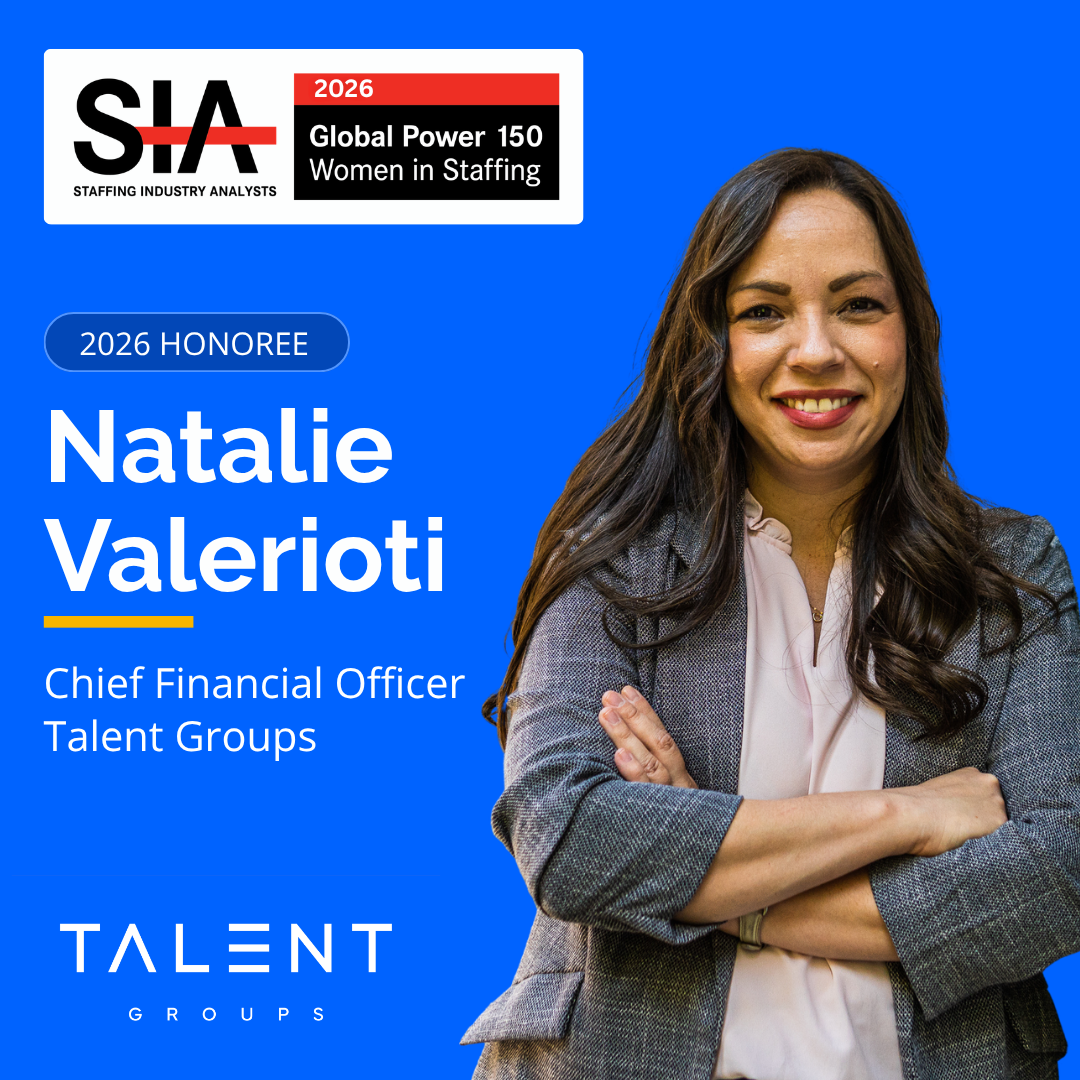
Talent Groups CFO Natalie Valerioti is named to SIA’s 2026 Global Power 150 Women in Staffing, recognizing her leadership and impact on the staffing industry.

By Amy Carabase
•
September 28, 2026
Key takeaways from AI in Action Las Vegas on practical AI adoption, operational value, governance, talent strategy, and keeping people at the center.

By Amy Carabase
•
September 21, 2026
Discover why today’s IT talent challenge is about skills, not headcount, and how organizations can close gaps across AI, cloud, data, and cybersecurity.